A data structure for Priority Queue with the union operation implemented as a Forest of Min-Heap connected by a Double Linked List.
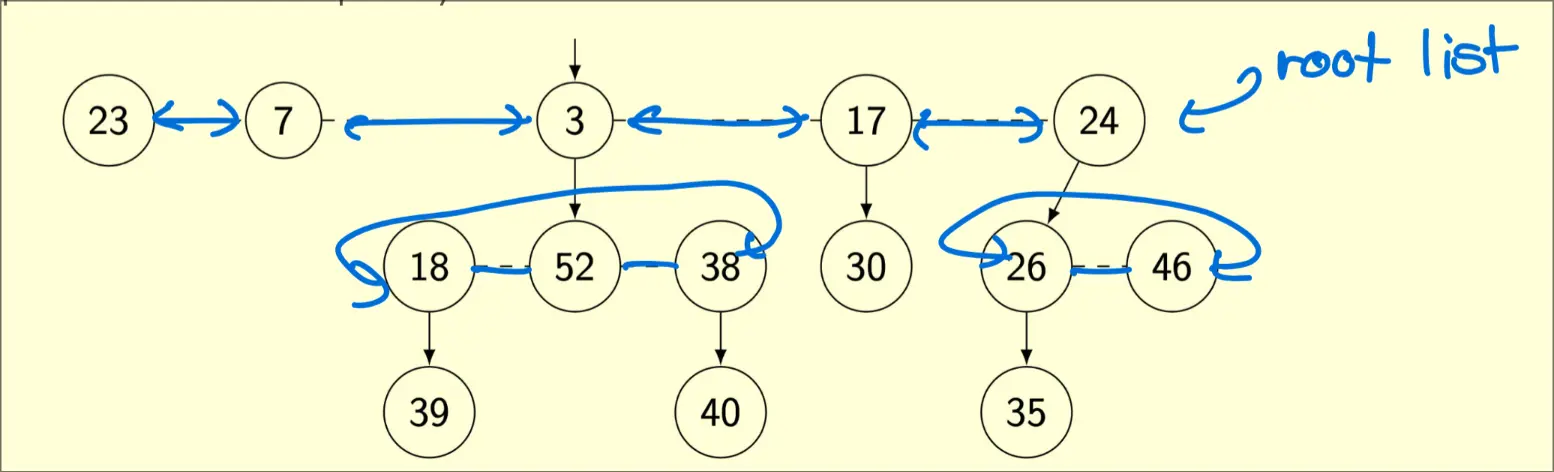
Structure
Node Structure
struct node_structure{
	int key; // used for priority
	struct node_structure* left;
	struct node_structure* right;
	struct node_structure* child; // ptr to one child
	int degree; // number of children
	bool marked; // indicates whether node has lost a child
}
Heap Structure
struct heap_structure{
	std::list<struct node_structure*> roots; // list of roots
	struct node_structure* min; // ptr to root node with minimum key
}
Operations
insert(H,k): insert keykunion(H, H1, H2): merge two heapsH1,H2decrease-priority(H,key): Decreases the priority of a keyextract-min(H): Extracts the min of a heapconsolidate(H): Reorder root list with nodes of unique degree
insert(H,k)
A operation
insert(H,k):
	new_root := new node(key=k, marked=false)
	add new_root to H.root_list
	if k < H.min.key:
		H.min = new_root
union_by_rank(H,n1,n2)
A amortized operation ( amortized) to merge two trees into one
union_by_rank(H, n1, n2){
	if n1.rank > n2.rank:
		remove n1 from H root list
		make n2 child of n1
	else if n1.rank < n2.rank:
		remove n2 from H root list
		make n1 child of n2
	else: # doesn't matter which child is replaced
		remove n2 from H root list
		make n1 child of n2
		n2.rank++
}
union(H,H_1,H_2)
A operation to merge two heaps into each other
union(H, H1, H2):
	H.root_list := H1.root_list + H2.root_list
	if H1.min.key <= H2.min.key:
		H.min := H1.min
	else:
		H.min := H2.min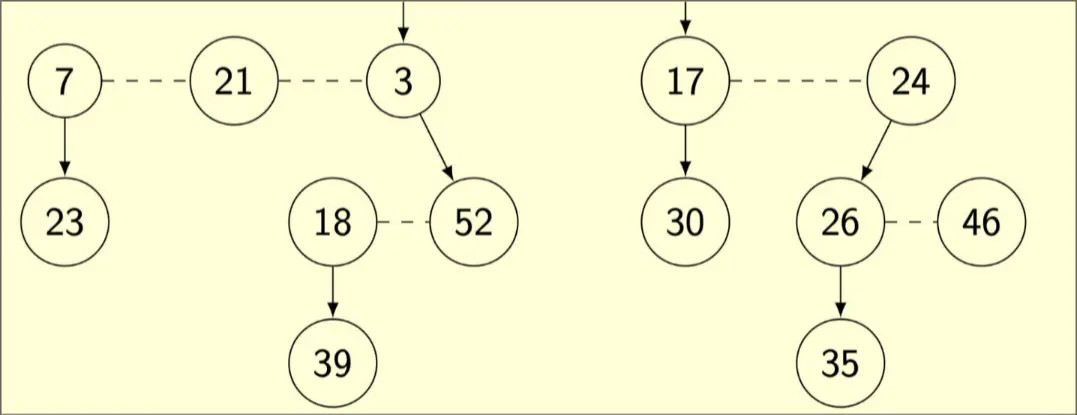
extract-min(H)
extract-min(H):
	remove H.min from H.root_list
	add each child of H.min to H.root_list
	H.min := any former child of H.min
	consolidate(H)
consolidate(H)
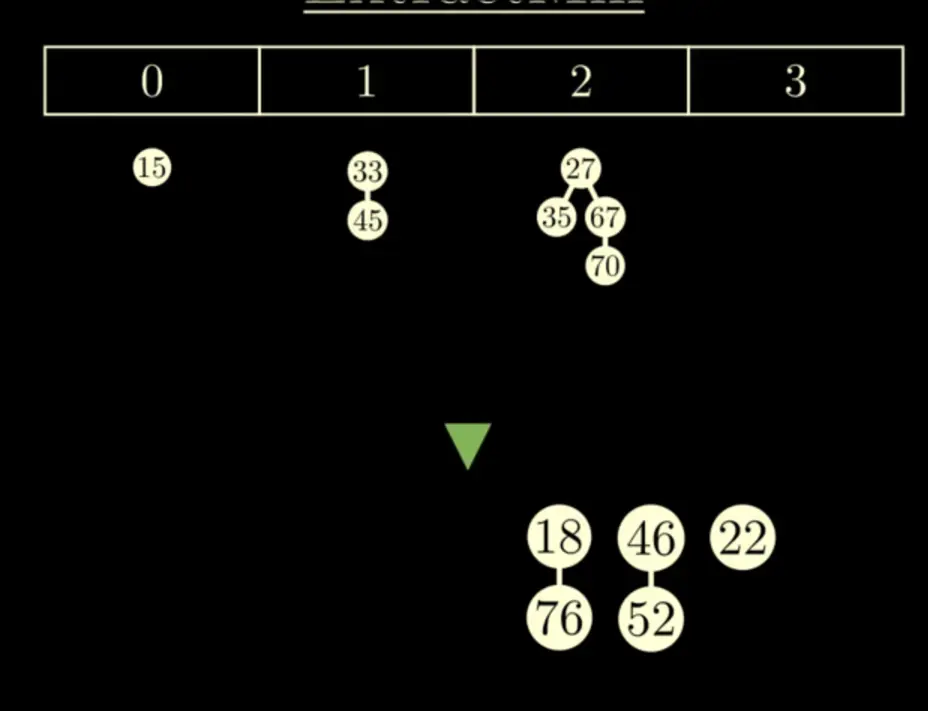 Attempts to make sure all roots in the list have a unique degree. Will find nodes that have the same degree and make the larger key a child of the node with the smaller key
consolidate(H):
	for each node n in H.root_list:
		x := n
		while A[x.degree] != null:
			y := A[x.degree]
			A[x.degree] := null
			if x.key > y.key:
				x,y := y, x
			remove y from H.root_list
			union_by_rank(H,y,x) # will make y child of x
			y.marked := false
		A[x.degree] := x
	update H.min
decrease-priority(H,x,k)
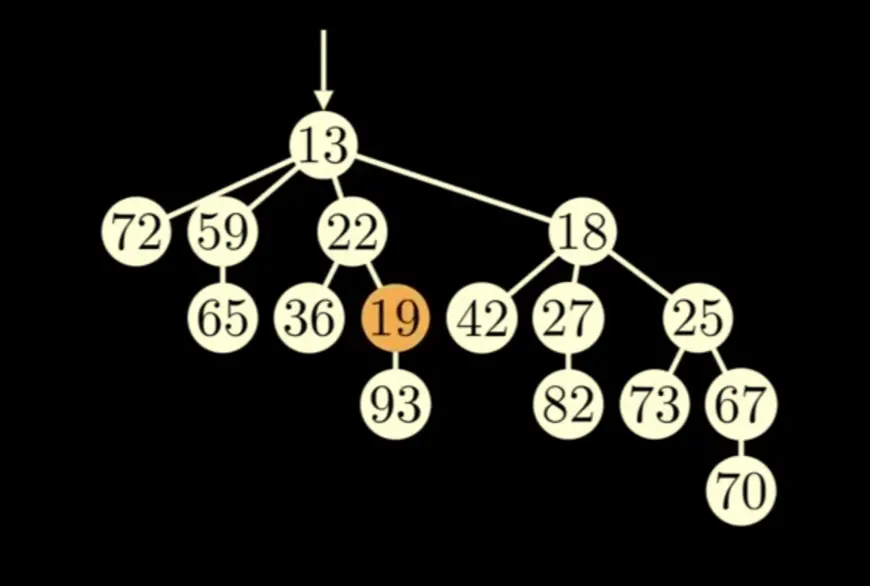
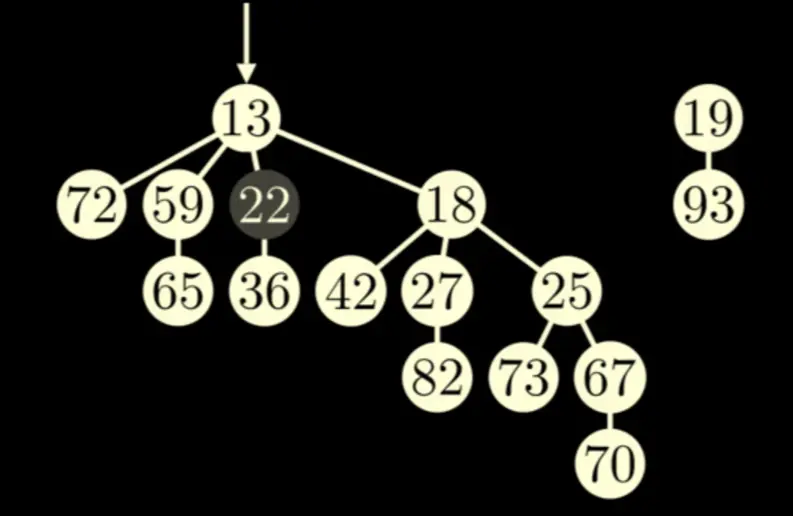
decrease-priority(H,x,k):
	if k >= x.key: return
	x.key := k
	y := x.parent
	if y != null and y.key > x.key:
		cut(H,x,y)

		// cascading cut
		while y.parent != null:
			if not y.marked:
				y.marked := true
				break
			else:
				cut(H,y,y.parent)
				y := y.parent

		if x.key < H.min.key:
			H.min := x

cut(H,x,y): # remove a node from its parent y and move it to root list
	remove x from children of y
	add x to H.root_list
	x.marked := false
	if x.key < H.min.key:
		H.min := x
Complexity Analysis
Define:
- : number of trees in heap (nodes in root list)
- : degree of node with maximum heap in heap
- : maximum possible degree of fibonacci heap with nodes
- : number of marked nodes in heap Then worst-case analysis:
extract-min()has complexitydecrease-priority(n,p)has complexity We can define potential function- Insert changes potential with
- Then,
- Amortized cost of decrease-priority is
- Amortized cost of extract-min is equivalent to Note that:
- - hence the name fibonacci heap
Fibonacchi Relation
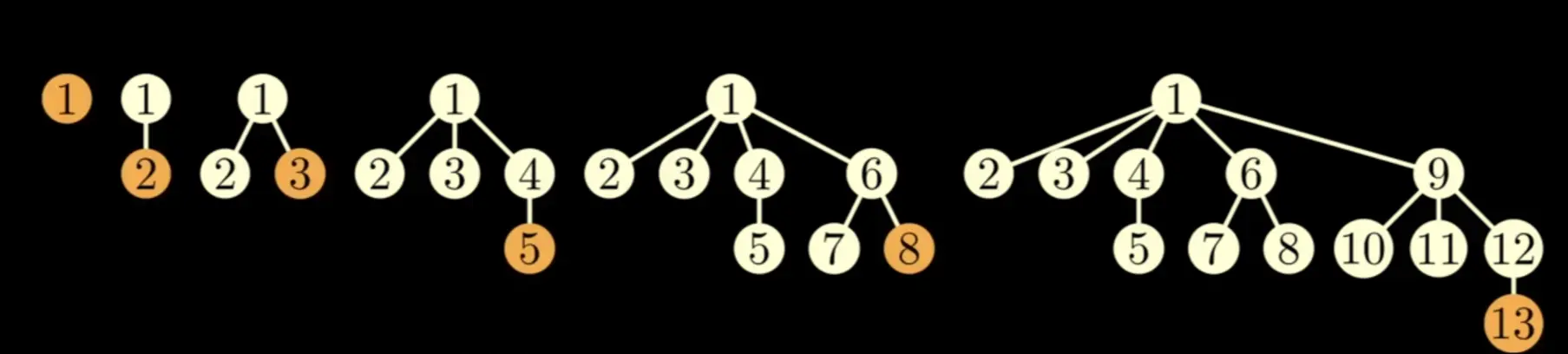 The size of the heaps has a similar structure to the Fibonacci Series where the size of a large heap is proportional in size to the previous smaller heaps.
Implies an exponential growth of Golden Ratio
The size of the heaps has a similar structure to the Fibonacci Series where the size of a large heap is proportional in size to the previous smaller heaps.
Implies an exponential growth of Golden Ratio