Using a Forest to create a Disjoint Set
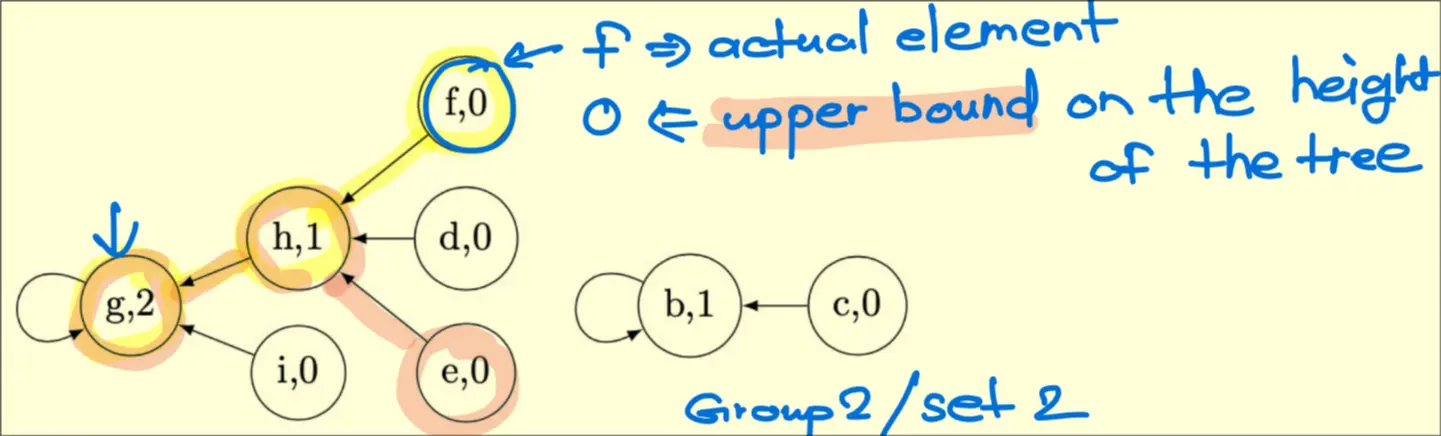
Implementation
- Each set is a Tree where child leaves have pointers to parents
- The root node points to itself
- Each node stores a rank (upper bound on height of tree rooted at node)
make-set()
Creates a single-node tree.
make-set():
	root := new node(value=x, rank = 0)
	root.parent := root
	return root
union(node1, node2)
With node1 present in one tree and node2 present in another tree, makes the root of the shorter tree a child of the taller tree.
union(node1, node2):
	link(find-set(node1), find-set(node2))
link(root1, root2):
	if root1.rank > root2.rank:
		root2.parent := root1
	else:
		root1.parent := root2
		if root1.rank = root2.rank:
			root2.rank++
find-set(node)
find-set(node):
	if node.parent != node:
		return find-set(node.parent)
	return node
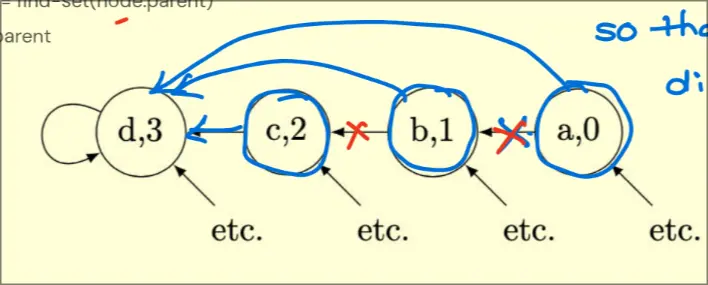
Path Compression Variant
find-set will update the parents of all nodes along the path of the node to the root to point to the root.
Complexity Analysis
- With as the number of elements
- With as the number of operations ()
- Best disjoint set implementation is forests
- Worse-case for operations with make-sets is
- Note that is the Inverse Ackermann Function
- is the number of times you need to apply log to until answer is https://cs.uwaterloo.ca/~r5olivei/courses/2020-fall-cs466/lecture1.pdf